How to choose a padel racket for your level
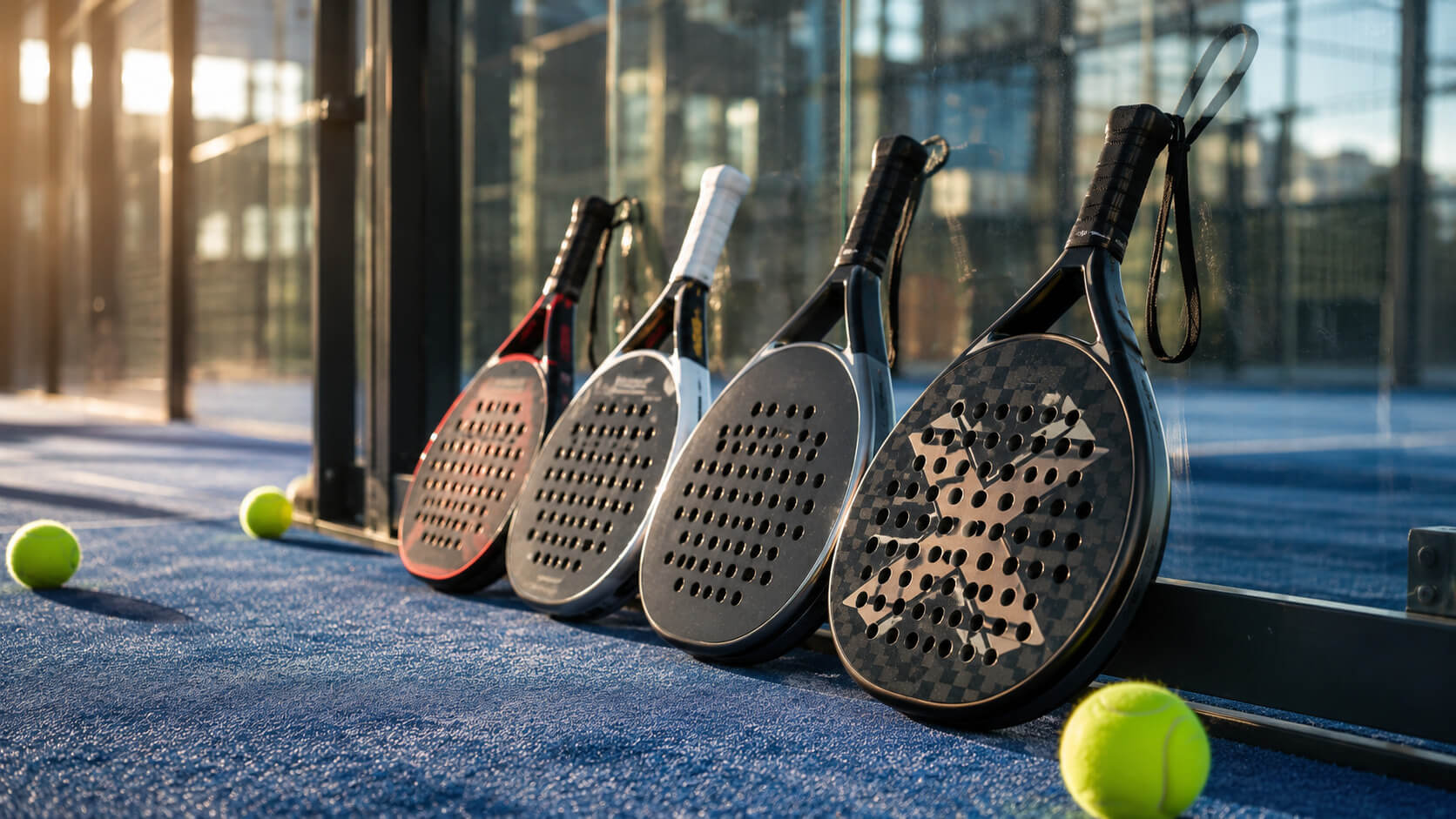
Choosing a padel racket is the single most important gear decision for any player. A poorly suited racket tires your arm, limits your precision and slows your progress. The right one, matched to your level and style, makes every game smoother and more enjoyable. In this guide we walk through the criteria that actually matter (shape, weight, balance, core and surface) to help you choose a padel racket with confidence.
The three padel racket shapes
The shape of the racket determines where the sweet spot sits, and therefore how the racket behaves overall.
Round: forgiveness and control
The round shape places the sweet spot in the center of the face. It is the most forgiving and the easiest to handle. It tolerates off-center hits and favours control.
Ideal for beginners and players who value consistency above all.
Teardrop: the all-rounder
The teardrop shape places the sweet spot slightly higher. It offers a good balance between control and power, making it the most versatile option.
Perfect for intermediate players who want to progress without losing handling.
Diamond: power and commitment
The diamond shape places the sweet spot high on the face. It generates a lot of power but demands solid technique and good positioning.
Reserved for advanced players who control their swing and look for hitting power.
Weight: an underrated factor
A padel racket usually weighs between 350 and 390 grams. This detail changes everything over the course of a match.
- 350-360 g: maximum handling, ideal for beginners and net players.
- 360-375 g: a balanced compromise, suited to most players.
- 375-390 g: more power and stability, but more tiring for the arm.
When in doubt, go for a lighter racket. Excess weight is the leading cause of tendinitis and elbow discomfort among regular players.
Balance: where the weight sits
The balance tells you how the weight is distributed along the racket.
- Low balance (towards the handle): handling, defence, fast net play.
- Medium balance: versatility.
- High balance (towards the head): power, smash, attacking play.
A beginner will almost always benefit from a low or medium balance: the racket is easier to position and the arm tires less.
The core: hard or soft?
The heart of the racket is made of foam of varying density.
- Soft core: easy ball release, comfortable, ideal for beginners and touch players.
- Hard core: more power and precision, but requires arm speed to unlock its potential.
The simple rule: the higher your level and the faster your swing, the more you can move towards a hard core.
The surface: rough or smooth
- Rough surface: generates more spin (slice, topspin), useful for crafted shots.
- Smooth surface: slightly more ball speed and cleaner contact.
For most players, this difference stays secondary to shape and weight.
Matching the racket to your level
Here is a quick reference to make the right choice:
- Beginner: round shape, 350-365 g, low balance, soft core. Comfort and control first.
- Intermediate: teardrop shape, 360-375 g, medium balance, medium core. Versatility above all.
- Advanced: diamond shape, 370-385 g, high balance, hard core. Power and commitment.
The right gear never replaces playing time: it is by stacking up matches that you truly learn what suits you. For more guidance, browse our Padel Tips category, and find partners at your level near you.
Materials: carbon, fibreglass and foam
Beyond shape, it is the materials that determine the feel and durability of a padel racket.
The face surface
- Fibreglass: softer, it offers an easy ball release and a comfortable touch. It is the ideal material for beginners and tight budgets.
- Carbon: stiffer and more durable, it brings precision and power, but demands a more polished swing. You find it on mid-range and high-end models.
Carbon comes in several weaves (3K, 12K, 18K…). The higher the number, the denser and stiffer the weave, so the more demanding the racket.
The EVA foam core
The internal foam, mentioned earlier, comes in various densities. A soft EVA favours comfort and forgiveness; a hard EVA maximises power and lifespan, but releases the ball less well if your arm speed is limited.
Simple rule: fibreglass + soft EVA to start, carbon + medium EVA to progress, carbon + hard EVA for confident hitters.
The grip and handle size
An often overlooked detail, yet decisive for comfort and injury prevention.
- Most padel rackets have a short, thin handle (around 38 cm long).
- You adjust the thickness with one or two overgrips: too thin a handle tires the forearm, too thick a handle reduces wrist mobility.
- Change your grip as soon as it becomes smooth or slippery: a racket that twists in the hand costs points and blisters.
If you sweat a lot, go for an absorbent overgrip; outdoors or in dry weather, a tackier overgrip is enough.
5 common buying mistakes
Avoid these classic traps that cost money and slow your progress:
- Copying a pro's racket: their ultra-stiff diamond models are unsuited to an amateur.
- Chasing power too early: a powerful racket you cannot control multiplies the errors.
- Ignoring weight: too heavy a racket is the leading cause of elbow discomfort.
- Buying without testing: if possible, try the racket in a real game before buying.
- Forgetting the total budget: add balls, overgrips, a protector and shoes to your calculation.
Maintenance and lifespan
A well-maintained padel racket lasts longer and keeps its performance.
- Fit a frame protector from day one: it absorbs friction against the walls and floor.
- Avoid leaving your racket in a car in full sun or in the cold: temperature swings weaken the foam and the glues.
- Store it in a cover, away from humidity.
- Inspect the frame regularly: a crack, even a fine one, signals a drop in performance and a risk of breakage.
With regular use (1 to 3 times a week), expect 1 to 2 years before you feel a real drop in performance.
Rackets for men, women and children
There is no strictly "men's" or "women's" racket, but the player's build and strength guide the choice.
- Lighter players: favour a 350 to 360 g racket with a low balance, easier to handle and gentler on the joints.
- More powerful players: a weight of 365 to 380 g brings stability without becoming tiring.
- Children and teenagers: junior rackets exist, shorter and lighter (around 300-340 g), suited to their build.
The decisive criterion is always comfort in the hand, not the marketing printed on the frame.
Where to buy and test a racket
Before deciding, the best move is to try the racket in real conditions.
- Many clubs offer loaner or test rackets: take advantage during a game.
- Specialist shops often have a test wall and tailored advice.
- Online, check the return policy and read detailed reviews on the actual weight and stiffness.
Testing two or three models side by side quickly reveals the one that fits you. Once the racket is in hand, the most important thing is to play: find a club near you and stack up matches to get used to it.
FAQ
Which padel racket should a beginner choose?
Go for a round, light racket (350-365 g) with a low balance and a soft core. It is forgiving, comfortable and makes learning the basic shots easier.
What weight of padel racket should I choose?
Between 350 and 375 g for most players. When in doubt, pick a lighter racket to protect your arm and gain handling.
Is an expensive racket always better?
No. High-end rackets are often more demanding (hard core, high balance). A mid-range racket suited to your level will help you improve far more.
How often should I replace my padel racket?
A racket used regularly loses performance after 1 to 2 years. If you feel a drop in responsiveness or comfort, it is time to replace it.
Do I need a different racket for competition?
Not necessarily. Consistency with your level matters most. If you play tournaments, a versatile racket you master beats a powerful one you cannot control.
Conclusion
Choosing a padel racket is above all about choosing one suited to your level: round shape and soft core to start, versatile teardrop to progress, diamond for advanced players. Always favour comfort and handling over raw power.
Once you have the right racket in hand, all that is left is to play. Discover the padel clubs near you and download Padeligo to find partners at your level in seconds.