Bandeja, víbora, chiquita: the essential padel shots
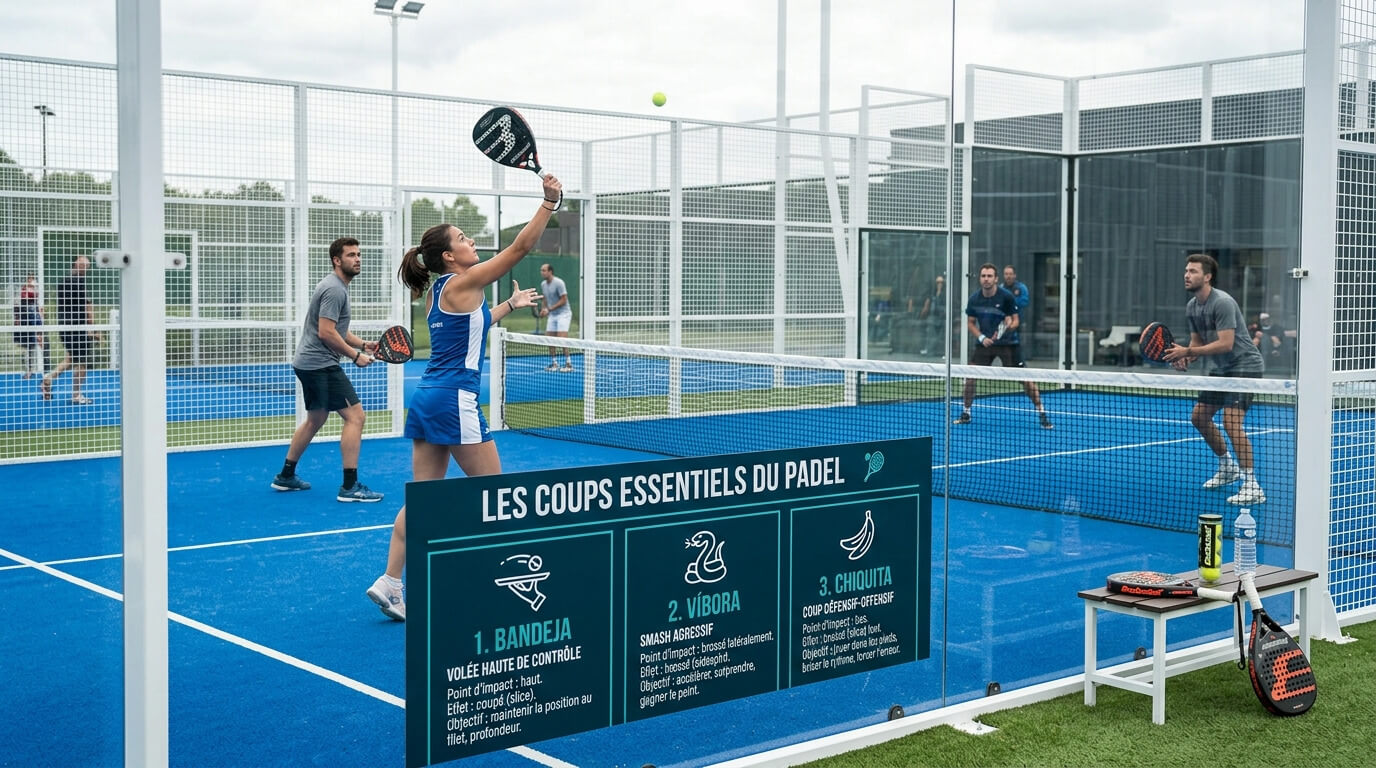
Padel has its own vocabulary, inherited from Spanish: bandeja, víbora, chiquita… Behind these names are specific shots that exist neither in tennis nor in squash, and that give the game its tactical richness. The good news: there are not fifty of them. Master a handful of essential shots and you will have an answer to almost every situation. Here is the guide, shot by shot: what it is for, when to play it, and how to work on it.
The bandeja: keep the net without taking risks
The bandeja ("tray" in Spanish) is THE signature shot of padel. It is a controlled overhead, struck at shoulder height with a "tray-carrying" motion: the ball is hit with slight slice, at moderate speed.
- When to play it: on an opponent's lob that is not deep enough, when you are at the net and want to stay there.
- Goal: it is not a winner, it is a holding shot. You send back a low, deep ball that stops your opponents from taking the net.
- Classic mistake: trying to hit it like a smash. The bandeja is played with footwork, not with the arm.
The víbora: the bandeja's aggressive sister
The víbora ("viper") starts from the same situation as the bandeja, but with a more lateral motion and a lot of spin. The ball shoots off after the bounce and slides along the side glass.
- When to play it: same situation as the bandeja, but when the ball is slightly higher and you want to put your opponent in danger.
- Goal: force a weak return or a direct error, without attempting the definitive smash.
- Prerequisite: master the bandeja first. The víbora is its advanced version.
The chiquita: the low ball that traps attackers
The chiquita is a softly played ball from the back of the court that dies at the feet of the players at the net.
- When to play it: when your opponents hold the net and the lob is not an option.
- Goal: force them to volley upwards, so you can move in behind it and flip the balance of power.
- The key: precision over speed. A chiquita that sits up is an easy volley handed over.
The lob: padel's most underrated weapon
The lob is nothing spectacular, yet it is the shot that swings the most points in amateur padel. Well measured, it pushes the opposing pair back and hands you the net.
- When to play it: whenever you are under pressure at the back of the court, or to dislodge opponents settled at the net.
- Goal: deep, high, ideally to the backhand side. The lob is a building shot, not a rescue shot.
Our guide on how to improve quickly at padel makes it one of the pillars of smart play.
Playing off the glass: the fundamental that separates levels
Playing the ball after it bounces off the glass is the most disorienting move for beginners, and the clearest divider between levels. The rules of padel allow the ball to rebound off the walls after hitting the ground: you must learn to use it.
- Step back early so you are not trapped against the glass.
- Let the ball drop into your comfortable hitting zone.
- Aim for a deep return, preferably cross-court, not a spectacular shot.
Twenty minutes of wall practice a week transforms your defence within months.
The smash "por 3" and "por 4": finish the point… or not
The smash in padel is not a reflex, it is a decision. Two winning variants exist: por 3 (the ball leaves over the side wall) and por 4 (over the back wall). But beware:
- A poorly controlled smash comes back into the court and offers an easy counter.
- Below a solid technical level, a firm víbora or bandeja is almost always more profitable.
- Save the definitive smash for high, central balls with a good base under you.
How to practise these shots effectively
- Isolate one shot per session: 20 minutes of bandeja beats 5 minutes of everything.
- Work with a partner who feeds you lobs or chiquitas in series.
- Film yourself: the bandeja motion you think you make and the one you actually make are often very different.
- Play themed matches: for example, no smashing allowed, to force bandejas and víboras.
FAQ
What is the difference between a bandeja and a víbora?
The bandeja is a control shot, hit flat or slightly sliced, to keep the net. The víbora is more aggressive: lateral motion, heavy spin, a ball that shoots off after the bounce. Learn the bandeja first.
Which shot should a beginner work on first?
Playing off the glass and the lob. These are the two fundamentals that win the most points in amateur padel, well before the smash.
Should you smash often in padel?
No. Unlike tennis, the smash in padel is risky: poorly controlled, it comes back into play and invites the counter. The bandeja and the víbora pay off more in most situations.
What is the serve called in padel?
The serve is played underarm, below the hip, after a bounce. It has no particular Spanish name, but it follows precise rules, detailed in our guide to the rules of padel.
Conclusion
Bandeja to hold the net, víbora to attack, chiquita to dislodge, lob to build, wall play to defend: with these five shots you have an answer to almost every situation in padel. Work on them one at a time, in real conditions: nothing replaces matches to make them stick. Download Padeligo to find partners at your level and multiply the chances to put them into practice.