Why padel is booming: the history and figures of a fast-growing sport
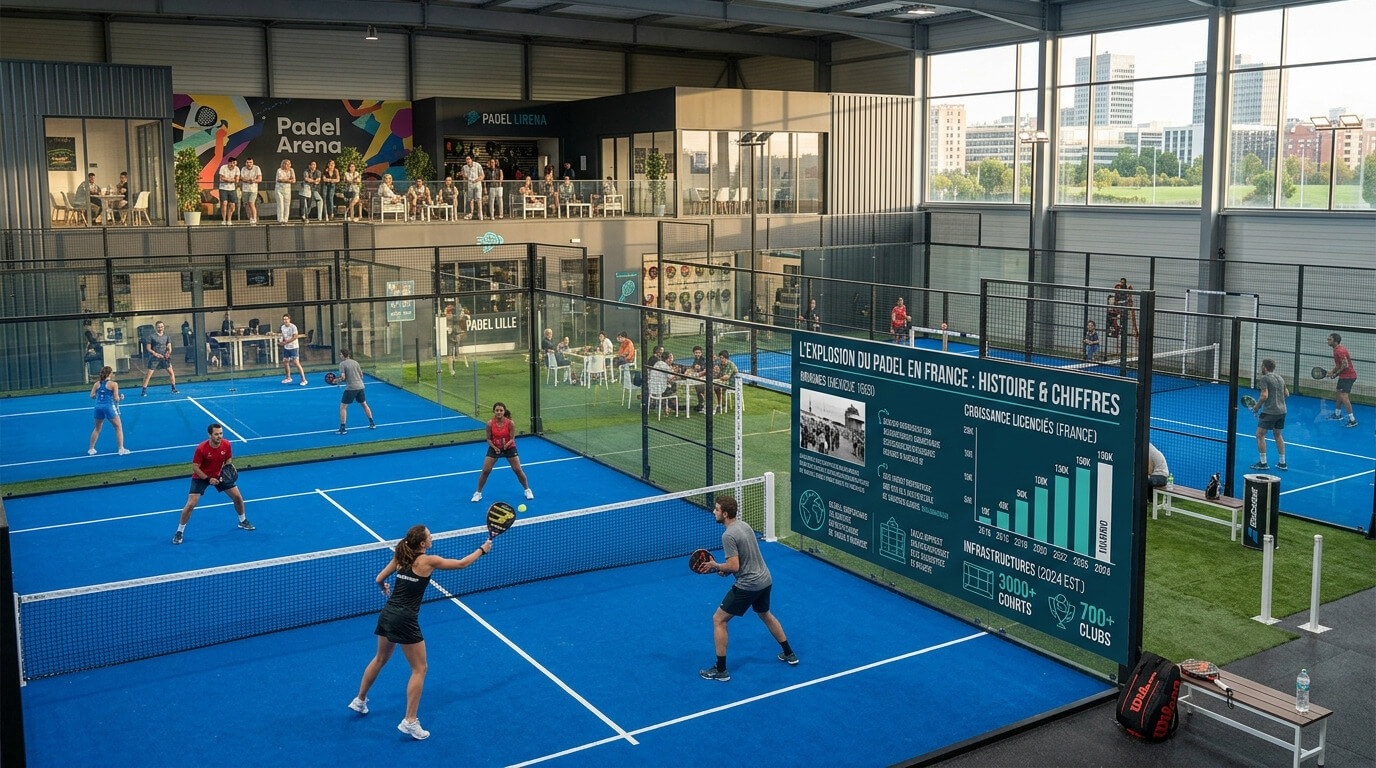
In just a few years, padel has gone from a niche sport to a global phenomenon. Courts springing up everywhere, celebrities racket in hand, bookings full weeks in advance: it is hard to miss. But where does this sport come from, and why is it so appealing? Here is a look at the history and figures behind a spectacular rise.
The origins: from Mexico to Spain
Contrary to a common belief, padel was not born in Spain but in Mexico, in 1969. Enrique Corcuera built a court surrounded by walls at his property in Acapulco: the "Corcuera paddle" was born.
The sport then crossed the Atlantic. A friend of Corcuera's, Alfonso de Hohenlohe, brought it to Spain in the mid-1970s and built the first courts in Marbella. From there, padel reached Argentina, which became one of its historic strongholds. For decades, these two countries concentrated most of the world's play.
The Spanish boom, the engine of growth
It was in Spain that padel became a mass phenomenon. Today it is one of the most played sports in the country, with thousands of clubs and millions of players. This Spanish base gave padel:
- A playing culture and a vocabulary (bandeja, víbora, chiquita).
- The best players in the world and a structured professional circuit.
- A club model exportable everywhere.
The recent global explosion
Since the mid-2010s, and especially since 2020, padel has grown at a dazzling pace well beyond its historic lands:
- The number of courts rising sharply across Europe (France, Italy, Sweden, Belgium…), the Middle East and the Americas.
- France is one of the fastest-growing markets, with hundreds of new courts every year.
- An increasingly televised professional world circuit.
- The arrival of celebrities and athletes (footballers, former tennis players) who popularise the sport.
Padel is regularly cited among the fastest-growing sports in the world.
Why padel is so appealing
This explosion is no accident. Padel combines rare strengths:
- Easy to pick up: you have fun from the very first session, unlike tennis.
- Social by nature: always for four, it is a sport of togetherness as much as competition.
- Financially accessible: the court is shared for four. See our guide on how much padel costs.
- Low-impact: less physically demanding than squash or tennis, playable at any age.
- Compact court: four padel courts fit on one tennis court, giving a profitability that appeals to investors.
This cocktail (fun, social, accessible) explains why so many new players get hooked after a single try.
What about tomorrow?
Padel keeps structuring itself: professionalisation of the circuit, talk of a bid for Olympic recognition, development of apps to find games and partners. The main challenge is no longer the sport's appeal, but access to courts and connecting players, precisely what platforms like Padeligo aim to solve.
FAQ
Where was padel born?
In Mexico, in 1969, thanks to Enrique Corcuera. It was then brought to Spain in the mid-1970s, then to Argentina, its two historic strongholds.
Why is padel so popular?
Because it is easy to pick up, very social (always for four), financially accessible and low-impact. You have fun from the very first game, which quickly hooks new players.
Is padel really the fastest-growing sport?
It regularly features among the fastest-growing sports in the world, with an explosion in the number of courts across Europe, the Middle East and the Americas since the mid-2010s.
What is the difference between padel and tennis?
Padel is played on a smaller court enclosed by glass, always in doubles, with an underarm serve. It is more accessible and more social. See our comparison padel vs tennis.
Conclusion
Born in Mexico, shaped in Spain and Argentina, padel has become a global phenomenon in just a few years thanks to a winning mix of togetherness, accessibility and immediate fun. The wave is only just beginning. Want to join the movement? Download Padeligo to find games and partners at your level near you.