Padel doubles tactics: positions and game patterns
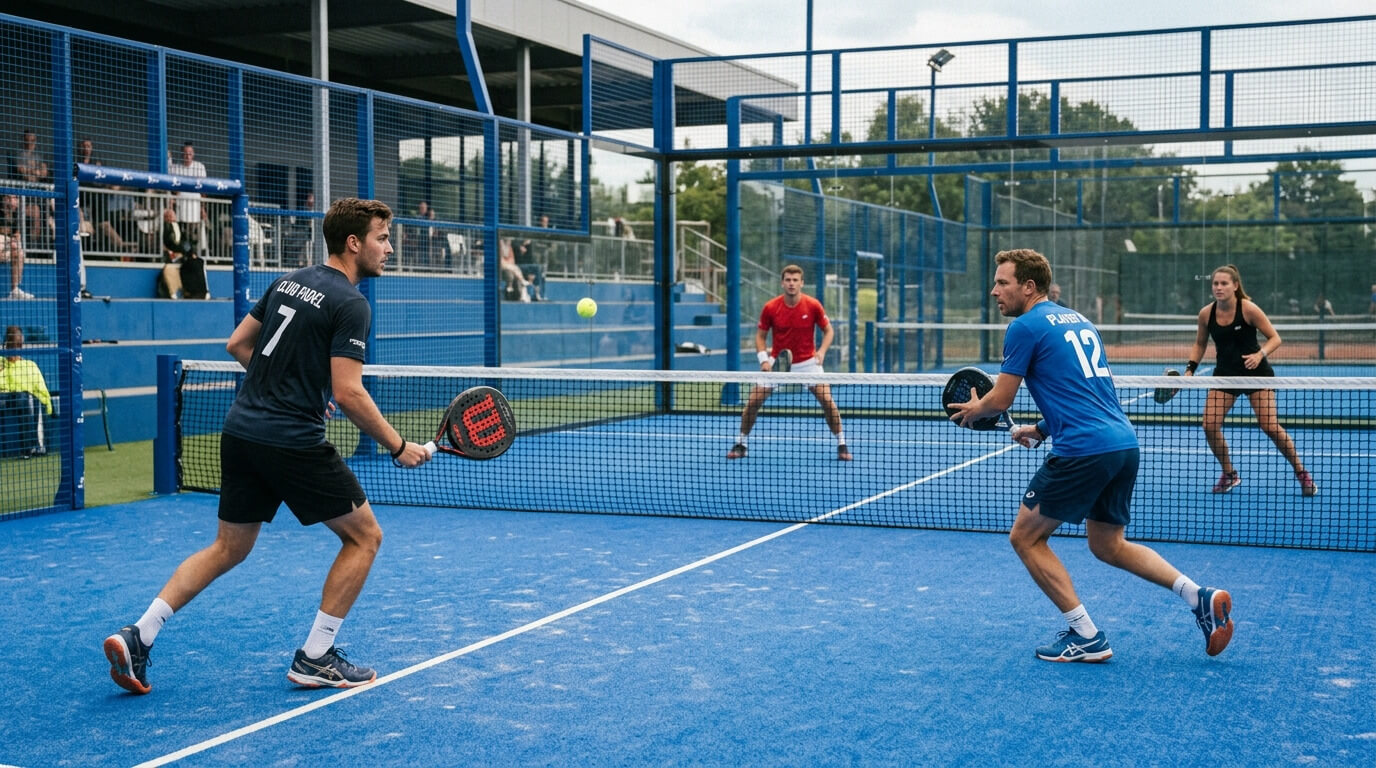
Padel is always played as a pair, and that is where matches are truly won. Two average but well-coordinated players regularly beat two more talented but disorganised ones. Doubles tactics are not reserved for experts: a few simple principles of positioning and communication are enough to swing matches. Here are the essential patterns to know to win more often.
The fundamental principle: play in mirror
The golden rule of padel: your pair moves as if tied together by a 3-4 metre rope. When one goes left, the other follows. When one moves up, the other moves up.
- Never one player at the net and the other at the back: that is a gaping hole handed to your opponent.
- Never both glued to the centre: the sides open up.
- Always side by side, covering the width together.
This simple reflex already corrects half of doubles positioning mistakes.
The two base positions
A padel pair constantly shifts between two situations:
- Attacking, at the net: the dominant position. Here you control the point with volleys and bandejas, trying to make your opponent hit the ball up.
- Defending, at the back: you are under pressure, buying time, looking to retake the net with the lob or the chiquita.
The whole game is about winning and keeping the net, and dislodging your opponent from it.
Pattern 1: the organised move to the net
Winning the net is the priority objective. The classic pattern:
- On serve, the serving team moves up to the net behind the serve.
- On the return, look for a deep ball or a lob to move up in turn.
- Once at the net, stay there by playing bandejas rather than risky smashes.
Whoever holds the net dictates the point. All tactics revolve around this conquest.
Pattern 2: aim for the middle
A ruthlessly effective principle: play through the centre, between the two opponents.
- It creates hesitation: "yours or mine?"
- It reduces the angle of their reply.
- It exposes pairs who do not communicate.
Always decide in advance, with your partner, who takes the middle balls (often the player with the forehand in the centre, or the better volleyer).
Pattern 3: attack the weaker player
In doubles, you do not play at random: you target the weak link. Send most balls to the less comfortable player, especially in key moments. This is not a lack of sportsmanship, it is playing smart.
Pattern 4: the lob to flip the balance of power
When your opponent holds the net, the lob is your best weapon to push them back and move up in turn. A good deep lob, to the backhand side, forces a defensive bandeja and hands you the initiative. It is one of the essential padel shots to work on first.
Communication: the glue of all tactics
No pattern works without talking. Before and during the match:
- Before: decide who takes the middle, who covers the lobs, your game plan.
- During: "Yours!", "I'm going!", "Leave it, it's out!".
- Between points: encourage, adjust, stay united.
A pair that communicates always looks stronger than it is.
Adapting your tactics to your partner
The best pair is not the two best players, but the two who complement each other:
- Attacker + defender: one finishes, the other builds.
- Right-hander + left-hander: two forehands in the centre, optimal coverage.
- Consistent + aggressive: one secures, the other takes risks at the right moment.
Playing often with the same partners builds precious automatic understanding; varying them from time to time reveals your weaknesses.
FAQ
What is the ideal position in padel doubles?
Both players side by side, moving in mirror as if tied by a rope. The goal is to win and keep the net together, never one player in front of the other.
Where should you play the ball in doubles?
Often through the middle, between the two opponents, to create hesitation and reduce angles. And primarily to the weaker player in key moments.
Who should take the middle balls?
Decide before the match. Usually the player whose forehand covers the centre, or the pair's better volleyer. What matters is that it is decided in advance.
How do you retake the net when defending?
With the lob and the chiquita. A deep lob pushes your opponent back and gives you time to move up; the chiquita forces them to volley upward so you can follow in behind.
Conclusion
Padel doubles tactics come down to a few principles: play in mirror, win the net, target the middle and the weaker player, and lob to flip the balance of power, all held together by communication. These reflexes are built in matches, not in theory. Download Padeligo to stack up games, test different partners and sharpen your pair play.